
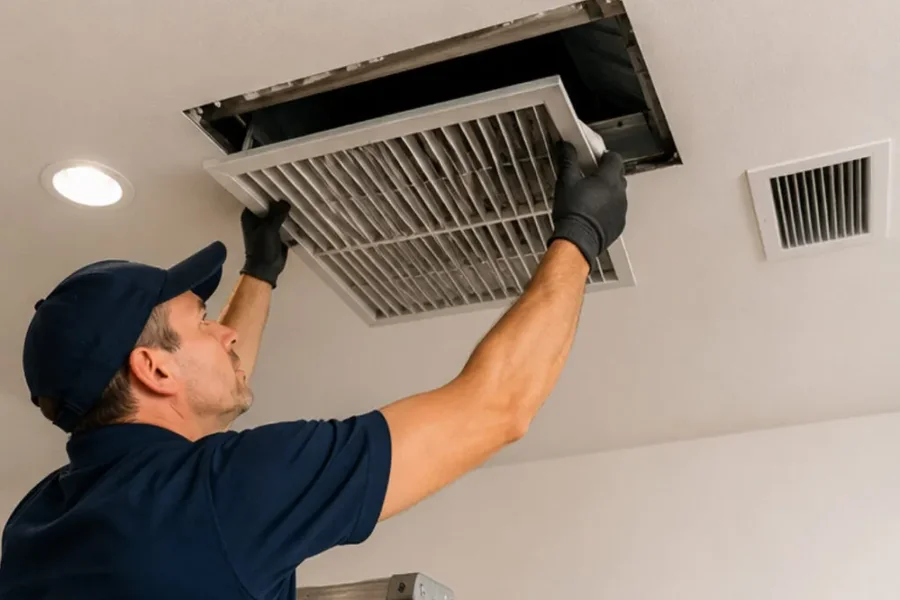
The dirtiest part of your HVAC system is the one you walk past every day without noticing. It’s that big grille low on a hallway wall, or high in a ceiling, pulling air back toward the furnace. Every speck of dust, dander, and cooking residue the house produces gets dragged across that grille, through a filter, and into the equipment. Then it comes back out of the supply vents as the air you breathe.
Most homeowners spend their attention on the supply side, where cold or warm air shows up. The return side is where the quality of that air gets decided. The two sides are doing opposite jobs, and treating them as the same thing is how indoor air problems take root.
Supply Vents Deliver Air While Return Vents Decide What’s In It
Supply vents get the credit because you can feel them working. Stand under one and you know within a second whether the system is on. Return vents don’t give you that feedback. They inhale steadily whenever the blower runs, and whatever is in the room goes with it.
That matters more than it used to because houses are tighter than they were a generation ago. The EPA explains that outdoor air enters a building through infiltration, natural ventilation, and mechanical systems, and when that exchange rate is low, whatever the house produces indoors stays indoors longer.
The return vent is the one piece of the system touching that air every cycle. A clean supply duct paired with a loaded return path still circulates the same debris, which is why routine duct cleaning tends to focus on the return trunk and the filter housing before anything else.
A Clean Filter Helps; A Starved Return Hurts
Upgrading the filter is the first move most homeowners make, and it’s a reasonable one. The catch is in that last clause. A denser filter captures more, but it also resists more airflow. If the return side is undersized, blocked by furniture, or missing grilles the house should have, a high-MERV filter can starve the blower. The symptoms look like equipment problems: short cycling, iced coils in summer, a furnace tripping on high limit in winter. The equipment is fine. It’s trying to breathe through a straw.
Here’s the honest comparison. A MERV 8 filter in a return system sized to move the air it needs can sometimes deliver cleaner indoor air than a MERV 13 in a return system that was rarely built for it.
Count Your Returns Before You Upgrade Your Filter
Walk the house and look. Many homes have one central return in a hallway and nothing else. Bedrooms with the doors closed become their own little pressure zones, pushing conditioned air out through cracks and pulling unconditioned air in through others. That’s a comfort problem and an air-quality problem at the same time, because it changes what the house is breathing.
- One return per floor minimum. A single grille serving two stories often means the upstairs rooms don’t get their air pulled through the filter at the rate they should.
- Bedrooms need a path. Either a dedicated return in the room or a transfer grille over the door. A closed bedroom with no return is a sealed box the system can’t condition properly.
- Keep the grilles clear. Couches, bookshelves, and curtains in front of a return cut airflow before the filter ever gets a vote. Pull the furniture back six inches and you’ve done more than most filter upgrades will.
The Case for Cleaning the Return Side First
Supply ducts collect dust too, but the return path does the heavy lifting. It carries unfiltered air, which means pet hair, construction debris from an old remodel, insulation fibers that slipped past a seam, and whatever the kids tracked in from the yard.
By the time any of that reaches the supply trunk, the filter has already caught most of what it’s going to catch. The buildup lives upstream.
If you’re deciding where to spend on duct work, the return side usually provides more benefits than the supply side. Clean the return trunk, replace a chewed-up filter rack, seal the connections at the air handler, and the whole system starts moving cleaner air without you touching the equipment itself.
When Does the Return Side Deserve a Professional Look?
Some signs are easy to read. Visible dust on the return grille within a week of wiping it. A whistle when the system kicks on, which usually means the return is undersized for the current filter. Rooms that smell different from the rest of the house.
A filter that looks loaded in a month when it used to last three is another tell. None of those point to broken equipment. They point to a return system that isn’t keeping up with what the house is asking it to do.
The supply vents will keep delivering air either way. Whether that air is worth breathing is a decision being made several feet upstream, at the grille nobody looks at.
